🐾 Does your dog panic when you leave? → Get the Free 7-Day


Natural remedies for dog anxiety: what actually works
We rank CBD, L-theanine, DAP, and more by evidence level — so you stop guessing and start helping your anxious dog feel calmer.

📌 This post may contain affiliate links. We earn a small commission if you purchase through our links, at no extra cost to you. This helps us keep the site free.
What “Natural” Actually Means – and What It Doesn’t
Natural means it comes from a plant, animal, or mineral source. It does not mean it’s effective. It also doesn’t mean it’s always safe.
Comfrey is natural. So is xylitol (found in some human supplements) – and xylitol kills dogs. The word “natural” is a marketing term, not a quality rating.
With that out of the way, some natural remedies do work for dog anxiety. The key is knowing which ones have been tested and at what dose.
The Evidence Matrix: Natural Remedies for Dog Anxiety Ranked
Strong Evidence
CBD / Hemp Oil
The most-researched natural option in this category. A 2023 study in Frontiers in Veterinary Science found hemp-based CBD reduced anxiety behaviors during separation and travel events. Effects were real but moderate – calmer, not knocked out.
Dosing matters: most studies use 2–4 mg/kg given 30–60 minutes before a trigger. Full-spectrum hemp oil (not CBD isolate) tends to perform better. Source from brands with third-party COAs, because the supplement market is full of products with almost no CBD despite the label.
L-Theanine Calming Supplements
L-theanine is an amino acid found in green tea that promotes mild relaxation without sedation. Several vet-recommended products (Anxitane, Composure, Solliquin) use it as a primary ingredient.
Research published in the Journal of Veterinary Behavior showed consistent reductions in fear responses during noise events. The catch: it works best with 4+ weeks of daily use. Giving it once before a thunderstorm won’t do much.
Blends that combine L-theanine with tryptophan or adaptogenic herbs (like Relora) tend to outperform single-ingredient products.
Recommended product: VetriScience Composure Calming Chews are a widely used dog-specific L-theanine supplement, formulated for daily use rather than one-off dosing.
→ Check today’s price on Amazon
Another daily oral option some owners try alongside or instead of L-theanine is Zylkene, whose active ingredient – alpha-casozepine, a milk-protein-derived peptide – works through a different mechanism, acting on GABA receptors rather than through green tea-derived L-theanine. Like L-theanine, it’s meant for ongoing daily use, not acute situations.
Recommended product: Vetoquinol Zylkene is our pick if you want to try this alternative mechanism.
→ Check today’s price on Amazon
→ Best Calming Supplements for Dogs – what’s in them and which brands actually deliver
DAP Pheromone Diffusers (Adaptil)
Dog Appeasing Pheromone (DAP) is a synthetic version of the pheromone nursing mothers produce. It doesn’t enter the bloodstream and it doesn’t sedate your dog. It just takes the nervous system down a notch.
Multiple controlled studies support its use for separation anxiety, kennel stress, and noise sensitivity. It won’t fix severe anxiety alone, but for mild-to-moderate cases combined with behavioral work, it’s consistently effective.
The diffuser format works best for home anxiety. The collar format is better for dogs whose anxiety spikes when they leave the house.
Note: ADAPTIL products are now sold under the ThunderEase brand in many markets, using the same clinically studied DAP technology under a new name.
Recommended product: The ThunderEase Dog Calming Pheromone Diffuser (formerly ADAPTIL) is a straightforward way to try DAP for home-based anxiety.
→ Check today’s price on Amazon
Moderate or Mixed Evidence
Exercise
This keeps getting buried at the bottom of supplement lists, which is backwards. A 30–45 minute walk or play session before a departure reduces cortisol levels and lowers baseline reactivity. A 2019 study in Applied Animal Behaviour Science found that structured physical activity reduced separation-related behaviors more reliably than several supplement interventions.
Try the walk before you buy the supplement. It’s free and it works.
Valerian Root
Mild sedating effects exist in some studies, but the dose-response curve is inconsistent in dogs. GI upset is common at higher doses. If you try it, use a dog-specific product with clear dosing – not human valerian supplements.
Melatonin
Some vets do recommend melatonin for dogs, particularly for noise anxiety and nighttime restlessness. The problem is human melatonin products often contain xylitol, which is toxic to dogs. Dosing is also very different – canine doses are much lower than human ones. Only use dog-specific formulations.
Weak Evidence or Real Risks
Lavender Essential Oil
One small study showed diffused lavender reduced kennel stress slightly. That’s the entire evidence base. The risk profile is another story: undiluted essential oils applied topically cause chemical burns and can be toxic. If you diffuse lavender, use a very low concentration in a ventilated room, and give your dog a way out.
→ Full breakdown: essential oils for dog anxiety
Chamomile and Most Herbal Blends
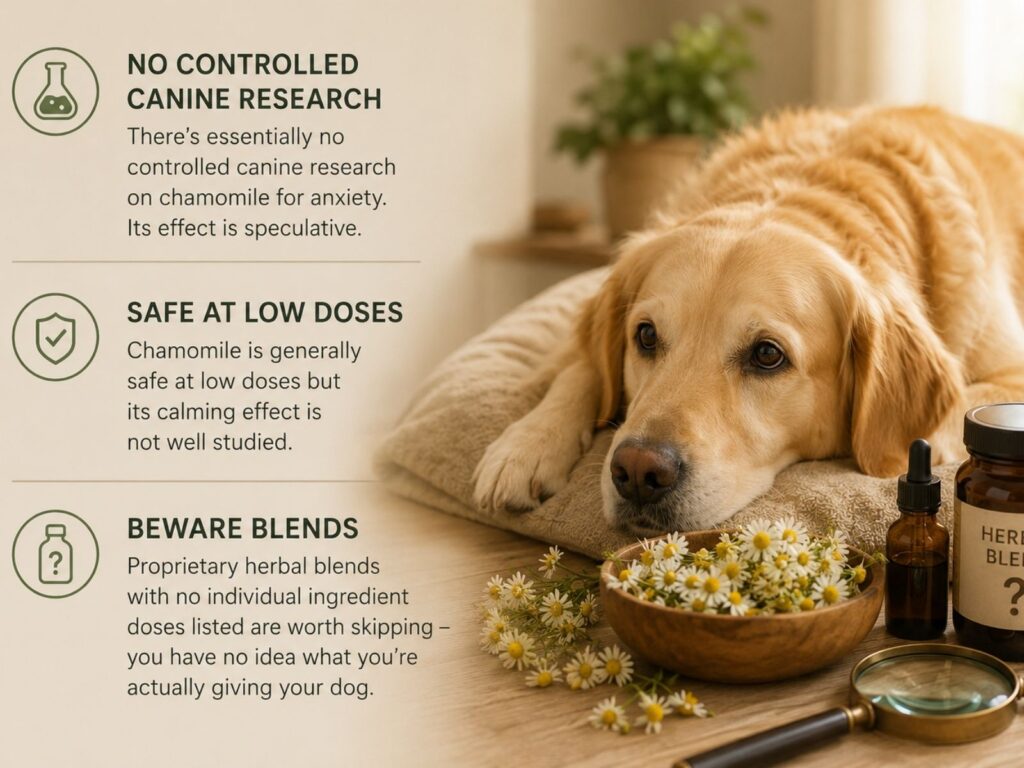
There’s essentially no controlled canine research on chamomile for anxiety. It’s safe at low doses but its effect is speculative. Proprietary herbal blends with no individual ingredient doses listed are worth skipping – you have no idea what you’re actually giving your dog.
Products Worth Trying
| Product type | What it does | Where to buy |
|---|---|---|
| Full-spectrum CBD oil (dog-specific) | Reduces anxiety behaviors; best before trigger events | → Best CBD options |
| L-theanine supplement (Anxitane / Composure) | Daily use for chronic anxiety | → Best supplement picks |
| ThunderEase diffuser (formerly Adaptil) | Home-based separation anxiety | Check Price |
Common Mistakes to Avoid
- Expecting instant results. CBD and L-theanine both require consistent use. They’re not emergency medications.
- Using human supplements. Doses and additives differ. Xylitol in human melatonin products can be fatal.
- Layering five remedies at once. Start with one, assess for two to four weeks, then add if needed. Otherwise, you won’t know what’s working.
- Skipping behavioral work. Natural remedies reduce reactivity. They don’t teach your dog that being alone is safe. Combine with desensitization training. If your dog’s anxiety is severe, read about prescription and OTC options.
Frequently Asked Questions
Are natural remedies enough for severe separation anxiety?
Rarely. For mild to moderate anxiety, CBD, L-theanine, and DAP can make a meaningful difference. For severe cases – destruction, self-injury, complete inability to eat when alone – vet-prescribed medication is usually necessary, at least initially.
How long before I see results?
CBD: 30–60 minutes for acute situations; 2–4 weeks for baseline shifts with daily use. L-theanine: 4+ weeks of daily use. Adaptil: 3–4 weeks for full effect.
Can I combine CBD and L-theanine?
Most vets say yes, though research on combination protocols in dogs is limited. If your dog is on any prescription medication, check with your vet before adding any supplement.
The Bottom Line
The most evidence-backed natural remedies for dog anxiety are CBD/hemp oil, L-theanine-based supplements, and DAP pheromone diffusers – used consistently, not just in crisis moments. Exercise is underrated and should come before anything else.
Natural remedies work best as a bridge: they reduce baseline anxiety enough that your dog can actually respond to training. They’re not a replacement for behavioral work, and for severe anxiety, they’re not a replacement for medication either.
Start with one option. Give it a few weeks. Then decide.
→ Best CBD Oil for Dog Anxiety (2025) – our ranked picks by evidence and transparency
→ Best Calming Supplements for Dogs – L-theanine blends that actually work
→ Read: Dog Separation Anxiety: The Complete Owner’s Guide
